

Spend ten minutes researching RF skin tightening and you’ll notice something: every device sounds exactly the same. Firmer skin. Tighter contours. No surgery, no downtime, no needles.
The marketing language is so consistent across platforms that it becomes genuinely difficult to understand what actually separates one device from another, or why the results you read about in reviews are so inconsistent from patient to patient. Some people rave. Some people shrug. And some people who’ve tried RF treatment elsewhere walk into Vibrancy and say they’re not sure it actually did anything.
The Cynosure TempSure doesn’t stand out because it promises something different. It stands out because of one specific engineering decision that changes how RF energy is delivered at the tissue level, and once you understand it, the inconsistency of most patients’ past experiences starts to make a lot of sense.
The Problem Nobody Talks About With Most RF Devices
Radiofrequency skin tightening works by heating tissue. The heat causes existing collagen fibers to contract and triggers the body to produce new collagen over time. The concept is solid. The clinical evidence is real. But here’s what most explainers leave out: the effectiveness of any RF treatment depends entirely on whether the tissue actually reaches and sustains the therapeutic temperature needed to trigger that collagen response.
Most RF devices deliver a fixed energy output. The provider sets the level, the device runs it, and whatever happens in the tissue — happens. The problem is that skin is not uniform. It varies in thickness across different zones of the face. Hydration level changes how tissue conducts electrical current. Fat distribution beneath the dermis affects how energy travels and dissipates. A fixed energy setting that’s appropriate for the cheek may be insufficient for the forehead, and potentially too aggressive for the delicate skin around the eyes.
This is why patients who’ve had RF treatments on other platforms often describe the experience as unpredictable — uncomfortably hot in some areas, barely perceptible in others. And it’s why results can be inconsistent from session to session even with the same device and the same provider. It’s not provider error. It’s a precision problem built into how most RF devices work.
What TempSure Does Differently — And Why It Actually Matters
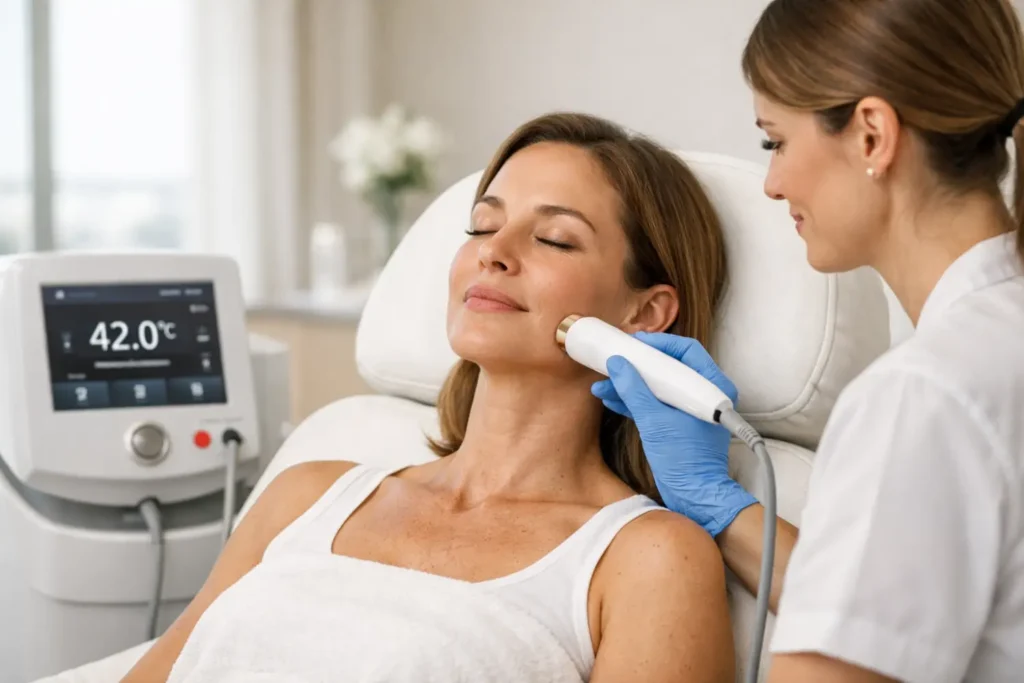
The Cynosure TempSure is built around a technology called Therapeutic Logic Control — TLC. It’s not a marketing label. It’s a real-time feedback system that fundamentally changes the relationship between the device and the tissue it’s treating.
Instead of delivering a fixed energy output and leaving the tissue response to chance, TLC continuously monitors the electrical impedance of the skin throughout the session. Impedance — how much the tissue resists the electrical current passing through it — shifts as tissue heats up. TLC reads those shifts in real time and automatically adjusts the energy being delivered to maintain a consistent therapeutic temperature, moment by moment, across every area being treated.
In plain terms: the device is always delivering exactly the right amount of energy for the specific tissue directly under the handpiece at that exact moment. Thinner skin near the eyes? It adjusts. Denser tissue along the jaw? It adjusts. Drier skin that conducts differently? It adjusts. The therapeutic temperature is maintained uniformly — not approximated, not manually managed by the provider — uniformly, by the device itself.
That is the difference between applying RF energy and actually controlling the tissue response. And it’s why TempSure’s results are more predictable, more reproducible, and more consistent than most patients have experienced from other platforms.
Why It Also Makes the Treatment Feel Completely Different
This isn’t just a clinical distinction — it changes the experience in the chair in a way that patients notice immediately.
Because TLC keeps tissue temperature within a controlled therapeutic range rather than spiking and fluctuating, what patients feel during a TempSure session is a steady, even warmth that stays consistent throughout. Not unpredictably hot in some spots and underwhelming in others. Just deep, consistent warmth — the kind that most people describe as genuinely relaxing, closer to a warm stone massage than anything they’d associate with a clinical device.
That matters more than it might seem. The patients who come back consistently for a full treatment series — and consistency is what produces results with any collagen-stimulating technology — are the patients who found the experience manageable. Even pleasant. The ones who gritted through something uncomfortable the first time and quietly decided not to return are the ones who never see what the treatment was actually capable of. TempSure’s comfort profile isn’t a luxury selling point. It’s a compliance driver, and compliance is a results driver.
One Platform, Several Treatment Zones — And Why That’s Significant
A lot of RF devices are designed with one primary application in mind. TempSure was built as a multi-zone platform with handpieces engineered for specific anatomical areas — because what works for the face isn’t the ideal configuration for the neck, and what works for the neck isn’t the right tool for body skin or intimate wellness applications.
Here’s what that looks like in practice:
- Face: Forehead, brow heaviness, periorbital lines, cheek laxity, nasolabial folds — the areas most patients think of first when they hear “skin tightening”
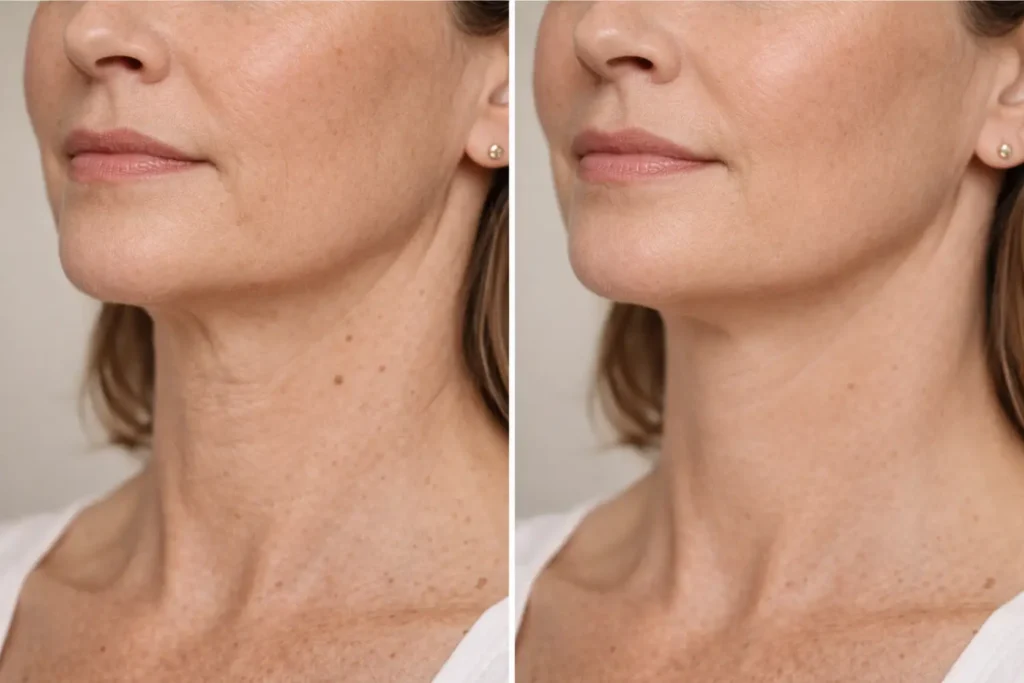
- Neck and jawline: Crepey texture, horizontal lines, early jowling — an area that responds beautifully to RF but requires a different energy approach than facial skin
- Body: Abdominal laxity, inner thighs, knees, elbows — areas patients often don’t realize can be addressed non-surgically
- Intimate wellness: The TempSure Vitalia handpiece applies TLC-controlled RF to vaginal laxity and external vulvar rejuvenation — a growing area of patient interest that demands exceptional precision
Having the right tool calibrated for each zone, rather than adapting one handpiece across all applications, is the kind of detail that separates a genuinely comprehensive result from a partial one.
Who Tends to Get the Most Out of TempSure
TempSure works across a wide range of patients, but a few presentations tend to see the most meaningful benefit.
Patients in their 30s and early 40s who are noticing early laxity and want to get ahead of it — rather than waiting until changes are more advanced — respond particularly well, because TempSure’s collagen stimulation works most effectively when there’s still a strong foundation to build on.
Patients who’ve had RF elsewhere and been underwhelmed often find that switching to TempSure produces the results they were expecting the first time around. And patients with darker skin tones who are rightfully cautious about light-based devices — lasers and IPL carry pigmentation risks that RF simply doesn’t — find TempSure to be one of the safest non-invasive tightening options available to them.
The one note worth making: TempSure works best for mild to moderate laxity. It’s not a surgical replacement for patients dealing with significant, advanced skin descent. A consultation at Serene Med Spas will always start by being honest about what the treatment is likely to do for you specifically — not what it does in the best-case brochure scenario.
The Precision Gap Is Real — And It Explains a Lot
If you’ve had RF skin tightening before and walked away underwhelmed, it probably wasn’t the technology’s fault — it was a precision problem. The Cynosure TempSure’s Therapeutic Logic Control addresses that problem at the engineering level, which is why the experience and the results consistently look different from what most patients have encountered elsewhere. At Vibrancy in Virginia Beach, VA we use TempSure because of exactly that distinction. If you’re curious about whether it could deliver what a previous RF experience didn’t, come in and let’s have an honest conversation about it.